

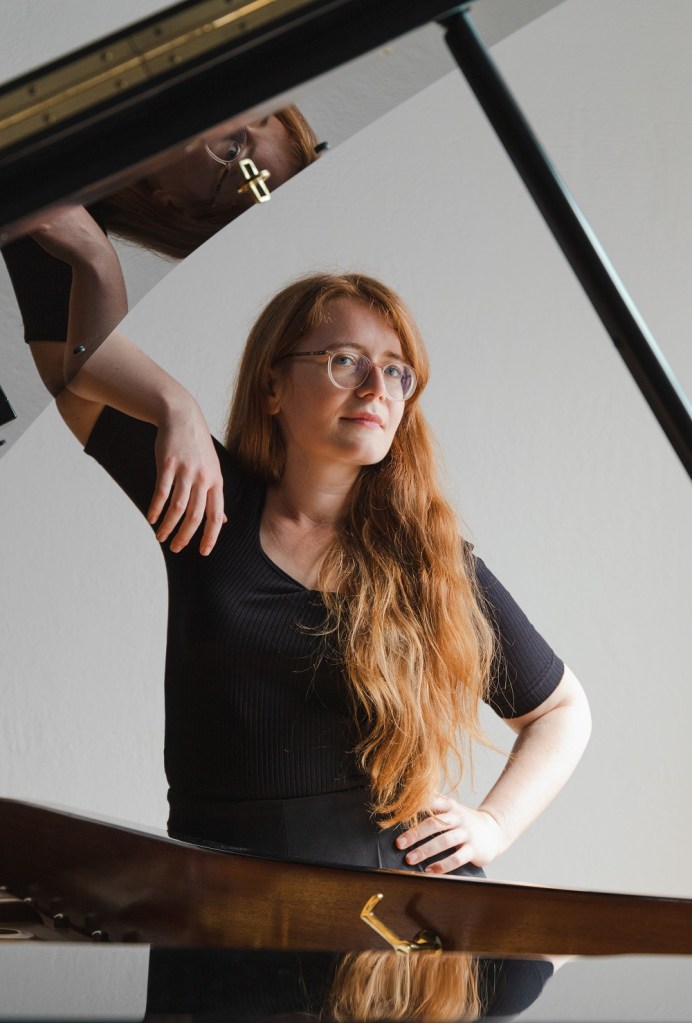
The multitalented Romanian pianist Aurelia Vișovan has earned international recognition for her impressive versatility across three distinct keyboard instruments: the modern piano, the historical fortepiano, and the harpsichord. With a career that combines solo performances, teaching, and a strong artistic curiosity, Vișovan stands out for her interpretations of rare and demanding repertoire.
On the occasion of her participation in a concert by the Thessaloniki State Symphony Orchestra, marking 100 years since the death of Moritz Moszkowski, Vișovan will perform the composer’s dazzling Piano Concerto No. 2 – a work of rare virtuosity and romantic brilliance. In this interview with notesfromlife, she talks about her artistic journey, her passion for historical instruments, the importance of teaching, and the fascinating dialogue between Moszkowski and Tchaikovsky that runs through the evening’s program.
Διαβάστε τη συνέντευξη στα ελληνικά.
INTERVIEW BY: GEORGIA SKONDRANI
Ms. Vișovan, you have had an impressive career performing on both historical and modern keyboard instruments. What led you to engage so deeply with the fortepiano and the harpsichord, in addition to the modern piano?
At first, simple curiosity. Around the time I finished high school I found out that most of the music I was playing on the piano was not written for this instrument. At first, I didn’t imagine it would be possible to see, let alone touch, such old instruments, I simply didn’t know they still existed. The first time I saw a harpsichord I was a student in Cluj-Napoca and my teacher insisted that I go and try to play my Bach piece on the harpsichord. It was a strange encounter, since this instrument is really very far away from what a piano is: not only is the sound a completely different one, but the technique of playing it was not at all intuitive. I played for a while but couldn’t get a hold of it. Later, when I studied in Vienna, I encountered almost by chance an incredible personality: Gordon Murray, the harpsichord professor, ended up teaching me from scratch how to unlock the wonders of these instruments, what to listen to, how they shape and affect the music I was playing. It opened new worlds for me, and I completely fell in love with it. Afterwards, trying historical pianos was a natural decision, since my curiosity about how the music used to sound at the time when it was composed was only growing!
In 2017, you gave the world premiere of George Enescu’s Piano Concerto. How did you experience this moment, and what were the challenges in interpreting and bringing to life an unpublished work?
Enescu’s Piano Concerto is a work he wrote in his youth. It reminds very much of Brahms, somehow, one can hear he was still looking for his own musical language. Nevertheless, it is very well written, as Enescu was a true child prodigy, much like Mozart was. It was an honor to get to perform it for he first time, alongside a wonderful conductor, Gabriel Bebeșelea, who is specialized on Enescu’s work.
As an artist who combines a soloist career with teaching, what is your personal philosophy as an educator? How do you convey your love for repertoire and interpretation to your students?
I believe that teaching has two components: on the one hand, there are the technicalities, where I need to be really focused on every student’s own and very personal needs, strengths and weaknesses. When it comes to the musical side and transmitting enthusiasm and love for the art, I believe personal example plays a huge role. Students tend to imitate and emulate their teachers, in both good and bad aspects. Whether I want it or not, I am aware that I play an important role in their development not only as musicians but also as human beings. It is very interesting to see how sometimes one can recognize students of a particular teacher by their personalities: if the teacher is an open and kind person, the students are for the most part open and kind as well. If the teacher is focused on competitiveness and has a selfish attitude, the students often become like this as well. I think therefore that the best I can do is give a positive example in all I do.
Ms. Vișovan, you are taking part in a concert of the Thessaloniki State Symphony Orchestra, performing for the first time with the orchestra Moritz Moszkowski’s Piano Concerto No. 2. How did you approach this piece, and what is your personal connection to Moszkowski’s music?
The performance in Thessaloniki will actually not be the first time I will perform this concerto. I already had the joy to play it in Romania in 2022, with the Transylvania Philharmonic in Cluj-Napoca, but it is true that it will be a Greek premiere and the first time I collaborate with the TSSO, which I am very much looking forward to. I think, at the moment, the Moszkowski Concerto is my absolute favorite piano concerto. At the same time, it is also the most difficult concerto I ever played. The soloist has nearly no break to take a breath and the piece is filled with difficult virtuoso passages. I expect to lose at least 2 kg on the concert day, haha! I hope that the audience will enjoy it just as much as I do: I think it is one of the rare classical music works which one gets to enjoy already from the first listening. One goes home whistling ist themes afterwards.
Paderewski once said that after Chopin, Moszkowski understood the piano best. Did you feel that while working on the concerto?
I definitely feel that. The concerto is incredibly well written for the instrument. At the same time, he must have been an incredible pianist himself if he managed to play all of this! He understands the piano and also knows how to get to its limits, this I can assure you of!
The concert program ends with Tchaikovsky’s Fourth Symphony – a work centered on the idea of Fate. How do you perceive the dialogue between these two works in the concert experience? Is there an internal thread that links them?
The Moszkowski concerto is a very light-hearted piece of music, I would say for the most part exactly opposite to Tchaikovsky’s Fourth. Nevertheless, it does have an incredibly melancholic slow movement, where the writing is strikingly similar to Tchaikovsky’s ballets. I had to think of Tchaikovsky many times when I was learning this piece, and it’s no wonder: Tchaikovsky actually took orchestration lessons from Moszkowski. It’s a great thing to get to listen to both teacher and student in the same concert!
What would you like the audience in Thessaloniki to feel through this special musical experience, which brings together the romantic grandeur of Moszkowski – still relatively unknown – with Tchaikovsky’s dramatic vision?
I can only hope they will get to love the concerto as much as I do, and that it will give them enough positive energy to balance out the powerfully dramatic Tchaikovsky for the evening. Can’t wait to share this music with everyone!
Main photo: Sofija Palurović
 notesfromlife