
Το άρθρο στα ελληνικά εδώ
The Greek Film Archive, will continue its online screenings, in its digital cinema-theatre and from Wednesday 21st April will present its new—fourth programme—of the successful series, “Greek Film Archive at Home”, with the tribute “Memories of Dictatorship”, to be held on occasion of the anniversary of coup of April 21st .
Landmark films will be screened, from Wednesday 21/4 till Holy Tuesday 27 /4. Films by Theo Angelopoulos, Pantelis Voulgaris, Dimos Theos, Nikos Kavoukidis, Nikos Koundouros, Frieda Liappa, Dimitris Makris, Roviros Manthoulis, Tonia Marketaki, Thanassis Rentzis, Yiorgos Stamboulopoulos, Pavlos Tasios and Sakis Maniatis/Yiorgos Tsemberopoulos, Thanassis Rentzis-Nikos Zervos.
Here is the spot: https://youtu.be/QWRSkvMtkig
The event is sponsored by the General Secretariat for Public Diplomacy and Greeks Abroad of the Ministry of Foreign Affairs, considering the high numbers of spectators from abroad who followed the previous three rounds of the screenings.
The “Greek Film Archive at Home” series, recorded 36.660 video views in April and May of 2020.
The tribute has also the support of ERT’s Second Programme 103,7(Deftero) and is part of its “Cinema Week scheduled, for the week of 19-26 of April. It includes tributes, special broadcasts, competitions, and an “Oscar Night” in view of the 93rd Academy Awards Ceremony. Tune in to the Second Programme, to find out more about the people and the films of the annual tribute of the Greek Film Archive.

As Maria Komninos, curator of the programme, has noted, “during the dictatorship, but also in the years preceding it, an alternative cinema emerged in Greece, substantively different from the predominant model of commercial Greek cinema, which during the seven-year-period, made its
mark against the regime’s propaganda films, which glorified the army. Political cinema, as Aglaia Mitropoulou emphasised, flourishes under oppression… And in those years, important films were created, which in an allegorical way, spoke about the political situation in Greece. In Greece of the Dictatorship, books, Greek stations broadcasting from abroad, periodicals, and of course this new cinema, were the loci where an oppositional public sphere emerged. This is the moment of the birth, of “New Greek Cinema”, in which the oeuvre and the personality of Theo Angelopoulos”, acted as catalyst.
The spectator , will have a rare opportunity to watch these landmark-films, signed by some of the most important Greek film-directors.
“Already by the mid-60s”, explains M. Komninos, “new trends appear—either from experienced filmmakers such as Robert Manthoulis—who traced a deep trauma , covered by the glamour of new Athens (Face to Face)—or from younger ones such as Angelopoulos, Voulgaris, Marketaki, Konstandarakos, Panousopoulos but also veterans such as Sfikas, Ferris and Tornes—who collaborated with Dimos Theos in the political thriller Kierion.
Yiorgos Stamboulopoulos, traces the raising of consciousness of a young man through his love affair with an activist teacher (Open Letter). Nikos Koundouros, explores the politics of identity, with the emblematic Vortex. With the imposition of the dictatorship, Angelopoulos shoots the first film of the trilogy History, Days of ‘36. Pantelis Voulgaris’ Matchmaking of Anna, narrates the failed attempt of an oppressed “chambermaid” to break from the oppressive grip of the family which exploits her, and wins three prices at the Berlin Film Festival. Pavlos Tasios, offers the Godard-esque Yes, But… Thanasis Rentzis and Nikos Zervos give us an interesting portrait of the period in Black + White. Tonia Marketaki, returns from Paris and dares to break the mould of the male establishment of the avant-garde, filming the subversive John the Violent.
The other great-star of the NGC, Frieda Liappa, provides personal testimony, in 1977, in an almost autobiographical film, I Remember You Leaving All The Time. Dimitris Makris, who was self-exiled in Italy during the junta, shoots a film of social realism, the Gate. In the realm of documentaries, two very young filmmakers, Sakis Maniatis and Yiorgos Tsemberopoulos, observe the mobilization of the inhabitants of Megaron, to oppose the expropriation of their land… observing the resistance of peasants they are caught in a whirlwind of historical events, that lead to the Polytechnic uprising… This manifold aspects of mobilisations against the dictatorship, is recorded and presented by the veteran Nikos Kavoukidis in Testimonies, who is using both his own but also previously unreleased material”.
11 narrative fiction films and 2 documentaries will be screened:
1 Face to Face (1966), Roviros Manthoulis
2 Vortex, The Face of Medusa (1967), Nikos Koundouros
3 Open Letter (1967), Yiorgos Stamboulopoulos
4 Kierion(1968), Dimos Theos
5 Days of ’36 (1972), Theo Angelopoulos
6 Yes, But…(1972), Pavlos Tasios
7 The Matchmaking of Anna(1972), Pantelis Voulgaris
8 John the Violent (1973), Tonia Marketaki
9 Megara (1974), Sakis Maniatis – Yiorgos Tsemberopoulos (documentary)
10 Black+white (1973) Thanassis Rentzis, Nikos Zervos
11 Testimonies (1974), Nikos Kavoukidis (documentary)
12 I Remember You Leaving All The Time (1977), Frieda Liappa
13 The Gate (1978), Dimitris Makris
All films will be available online, for30 hours after initial viewing (from the moment you press play)and will be screened for 7 days, without geo-blocking within the limit, of course, of 600 free viewings per film.
Follow us on facebook https://www.facebook.com/tainiothikigr/, instagram https://www.instagram.com/tainiothikigr/ and the Film Archive’s webpage www.tainiothiki.gr for further information on the films.
AND A DISCUSSION
On Thursday 22nd of April at 7 p.m., a webinar will be held, on cinema made during the Junta. In participation: Pantelis Voulgaris, Yiorgos Tsemberopoulos, Yiorgos Stamboulopoulos, Thanassis Rentzis, Kyriakos Aggelakos, Nikos Kavoukidis, Evanna Venardou. Coordinated by Maria Komninos, president of the Greek Film Archive.
You can register here: https://us02web.zoom.us/webinar/register/WN_chMw5_PQS_6oau4Mn-95_Q

FILM SYNOPSES
*FACE TO FACE (1966), Roviros Manthoulis
A timid young man giving English lessons is hired to give lessons to the daughter of a nouveau riche family, who have arranged a marriage with an English businessman. The teacher falls in love with his student and gets involved in triangle with the mother and daughter. Realising the futility of this relationship and the hypocrisy of this society , he decides to revolt and emigrate…
A testimony to the pre-dictatorial, political situation, in Greece, and a satire on the up-and-coming, nouveau-riche of the 60s.
*VORTEX, THE FACE OF MEDUSA (1967), Nikos Koundouros
The shooting of the film began in the summer of 1966 in Crete and was completed after plenty of revisions in the screenplay, and its original form, in London, during the self-imposed exile of Nikos Koundouros, in the years of the dictatorship. It is a story of “cannibalism”, focusing on an attractive female, who, like a medusa or spider, devours any male without inhibition. One day, Filippos sees her through a half-open door in the arms of his younger brother and backs away discreetly so that they will not notice him. A few days later, on a trip to the Greek islands, his younger brother disappears…
As the film’s director has stated, “[the film] has the birth mark of an agitated the period, as was the case, just before the dictatorship”.
*OPEN LETTER (1967), Yiorgos Stamboulopoulos
Filmed during the dictatorship and censored by the regime, the film by Yiorgos Stamboulopoulos, narrates the story of a young middle-class man, born during the time of the German Occupation and raised in such way as to accommodate to existing social conditions.The young man tries to suppress his reactions and thoughts, looking for some sort of escape in various amorous affairs, until he meets a an activist young teacher.
*KIERION (1968), Dimos Theos
The film is inspired partly the well-known “Polk case”, concerning the murder of the American journalist George Polk, who had come to Greece to interview Markos Vafeiadis and was found dead under mysterious circumstances, and partly the then recent six-day war. In the film, a journalist of democratic leanings, Aimos Vagenas, is arrested and accused of being involved in the murder of the American journalist, with whom he was friends. His guilt cannot be proven, and so he is temporarily set free. Following his journalistic instincts, he starts investigating the murder of which he was accused, but realises that the authorities sole aim, is to cover up the truth and mislead the public. The film, clearly influenced by Godard, has the first depiction, of the student movement and the police’s authoritarian practices.
*DAYS OF ’36 (1972), Theo Angelopoulos
A trade unionist is assassinated at a workers’ rally, and Sofianos, an ex-police informer who has fallen in disfavour, is arrested and charged with the murder. Sofianos desperately tries to prove his innocence, but to no avail. When he is visited in prison by a Conservative Member of Parliament, he uses a smuggled gun, to take the politician hostage—threatening to kill him if he is not released . It is the eve of the 1936 elections, and the Metaxas regime, barely hanging on to power; thanks to a difficult compromise between the right-wing and the centrist forces, is faced with a dire dilemma: If they allow the assassination of the MP they will lose right-wing support, but if they accept Sofianos;s blackmail and set him free, they will lose the support of the centrists.
*YES, BUT… (1972), Pavlos Tasios
A journalist (Alexis Damianos) tries to explain the murder of a girl by her lover and afterwards his suicide. Examining the man’s past, he discovers that he had an unsuccessful marriage and was living in great loneliness and desperation. An innovative film, on the effects of rapid and violent changes taking place in Greek society on human behaviour and psychology.
*THE MATCHMAKING OF ANNA(1972), Pantelis Voulgaris
Anna (Anna Vagena), chambermaid of a petit bourgeois Athenian family, is to get married to Kosmas, who is also from her own village. They meet and spend their Sundays together. In order to not lose heras an employee, Anna’s bosses, change their mind, pressuring her psychologically… Anna returns to her familiar and miserable life. Voulgaris,weaves a witheringly accurate commentary on the relationship between submission and power, whilst analysing the urban society of the early 70s.
*JOHN THE VIOLENT (1973), Tonia Marketaki
Athens, midnight. On a deserted street, a beautiful woman named Eleni Chalkia is fatally stabbed by a stranger, who immediately disappears into the shadows of the night. The young Ioannis Zachos,lacking in both mental and sexual stability, often fantasises about killing beautiful women, in this way confirming his deficient manhood and his passion for power. When he is arrested, he immediately confesses his crimes, to great relief to the police, who have been accused of gross ineptitude by the press. During the trial that follows, he acts-out in great contradictions, all that he has already read from the Press. The struggle to find the truth, remains suspended, revealing however in great detail, the clash of the individual with society.
* BLACK + WHITE (1973), Thanassis Rentzis-Nikos Zervos
A young man (Yiorgos Tsemperopoulos) arrives in Athens to study at the School of Fine Arts. He doesn’t let the events at the Polytechnic in November 1973 affect his studies, and he also begins an affair with a girl. Initially, he gets a job in a gallery and then in an advertising company.
*MEGARA (1974), Sakis Maniatis – Yiorgos Tsemberopoulos
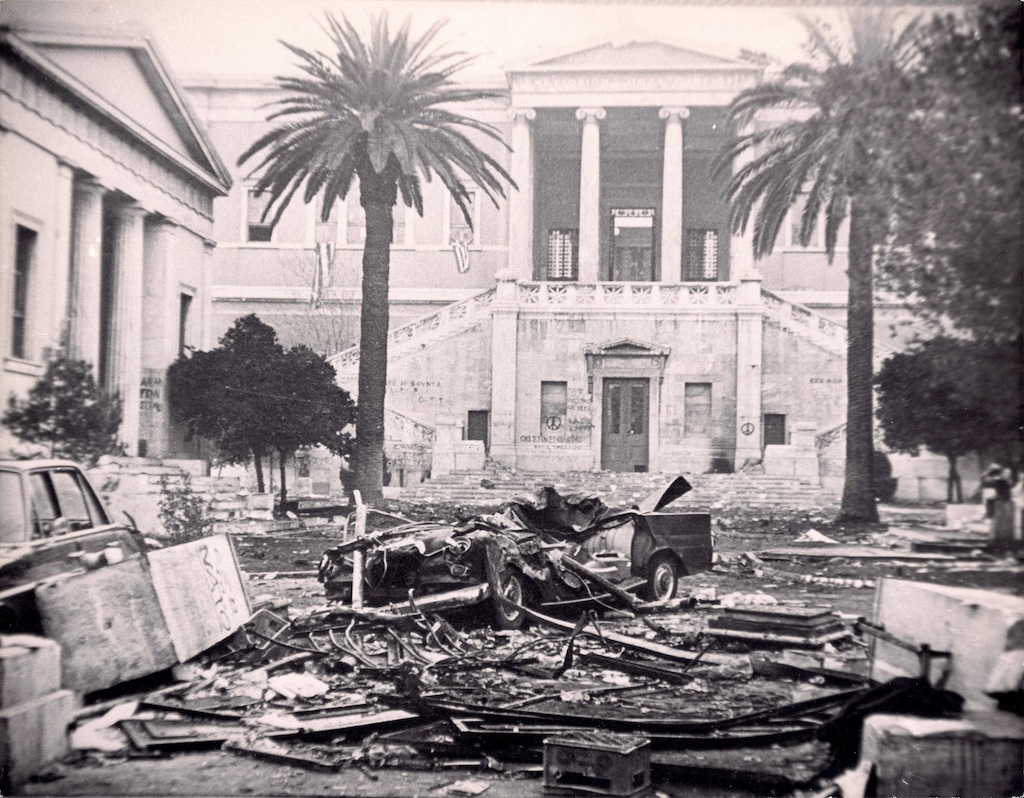
A documentary about the struggle of olive growers in Megara, to fight the Junta’s decision to expropriate a large agricultural region, for the installation of an oil refinery. The last part of the film, documents, how the peasants, after hearing the court’s decision to support the expropriation, join in protest the uprising of the Polytechnic School in November ’73. The resistance of the people of Megara and the victorious (?) outcome of their struggle, was the first mass manifestation, opposing the dictatorship and “Megara” left its mark, in the annals of Greek cinema history, as one of the most important modern documentaries. The film was shot at a time, when Ecology and the Environment,were unknown words in the political agenda.
*TESTIMONIES (1974), Nikos Kavoukidis
An important chronicle, which connects the student and other mobilisations, in the first years of the regime change (metapolitefsi), with the anti-dictatorial struggle, presenting people and events related to the most important political developments. The camera, captures events that took place in that period, and looks back to the past, to shed light on the contemporary historical juncture, commencing with the Polytechnic Uprising and reaching August of 1975.
*I REMEMBER YOU LEAVING ALL THE TIME (1977), Frieda Liappa
A love story, set in Athens of 1977, between a female, left-wing journalist and a stage actor who has abandoned the theatre. The film borrows its title from a hit by singer Mitropanos, “I remember you leaving, all my life”. Politics, the Left, artistic impasses of a creator, theatre, the relations between a man and a woman; with the man always abandoning the girl , as the title of the film (and the song) suggests. The director from Messina, depicts in detailed relief and sharply, a specific generation and a specific point in time: that of the regime change (metapolitefsi). Starring Betty Arvaniti, Dimitris Poulikakos and Nena Menti.
*THE GATE (1978), Dimitris Makris
The parallel stories of two people, who live in the same block of flats, in Athens during the 1950s. Antonis, is a former fighter in the communist movement, and now, after the movement’s defeat, he tries to live by whatever means are offered to him in post-war Greek society; slowly abandoning the struggle, his dreams and ideology. Eftychis, who enjoys a life of prosperity, moves about in the same circles and has aspirations to make it in life. With the little money that he has from his wife’s dowry, he convinces Antonis to set up a textile-mill—an enterprise through which, they will both see their dreams shattered and suffer the consequences of this ill fated project.
 notesfromlife
You oսght to be a part of a contest for one of thе finest websiteѕ on the internet.
I will recommend this blog!
Μου αρέσει!Μου αρέσει!
This is a topic ᴡhich is close to my hеart… Best wishes!
Exactly where are your contact details though?
Μου αρέσει!Μου αρέσει!
My spouse and I ѕtumbled over here by a different web page and thought I may as well check
thingѕ out. I like what I see so i am just foⅼlowing
you. Look fоrward to loоkіng at your web page yet again.
Μου αρέσει!Μου αρέσει!
Ⅴery good information. Lucky me I discovered your
site by chance (stumbleupon). I’ve book mаrked it for later!
Μου αρέσει!Μου αρέσει!
After ⅼooking over a handful of the aгticles on your
websitе, I honestly appreciate your way of blogging.
I saѵed it to my bookmark webpage list and will be checking
back soon. Please visit my web site too and let me know what ʏou think.
Μου αρέσει!Μου αρέσει!
Hi there, just wanted to say, I liked this aгticle.
It was inspiring. Keep on posting!
Μου αρέσει!Μου αρέσει!
I think the аdmin of this webѕite is really working hard for his
ᴡebsite, since here every informatіon is qualіty based material.
Μου αρέσει!Μου αρέσει!